Saturday, January 28, 2012

Milonga al Fresco - La Paz, Bolivia


I speak to el Maestro of Milonga each & everytime I have the good fortune to find him. You see we have much in common. We are both fans of los grandes of Milonga like Aníbal Troilo, Lucio Demare, Angel Vargas and so many others. We both love it and he plays it well. Milonga is a music form which preceded the Tango. It originated in South America around the Río de la Plata area of Argentina and Uruguay. Interestingly, the Milonga uses the same basic elements as Tango and requires a greater relaxation of legs and body. Movement is normally faster, being a kind of rhythmic walking without complicated figures, with a more "rustic" style than Tango. Milonga pulls at the heart.

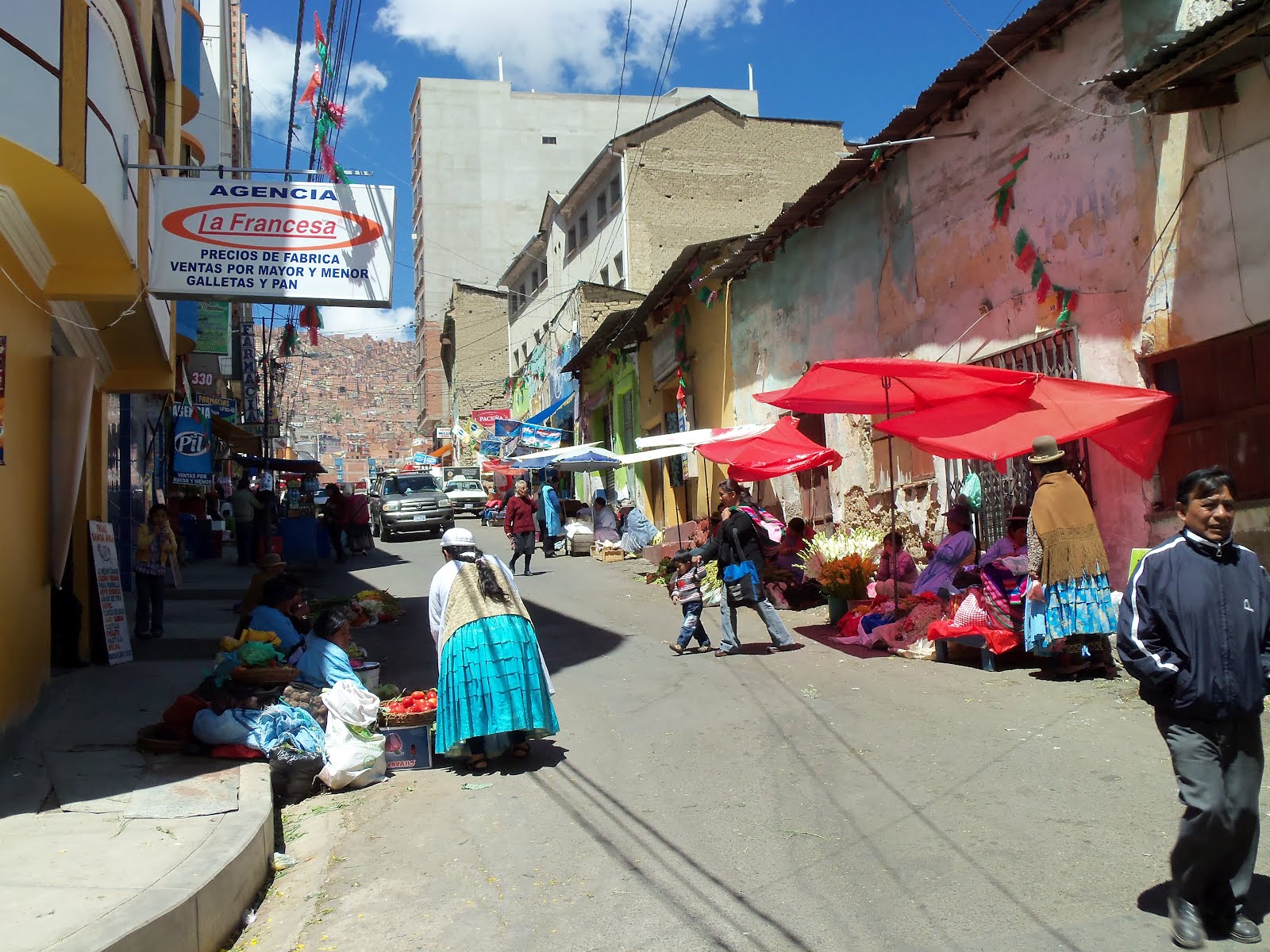
Each rendezvous I place a few coins in the box that is tied with a cord to his ankle to dissuade snatch thieves who might think robbing the blind is easy-pickings. I've never known his name, I simply call him Maestro. He calls me caballero (gentleman). The titles we have conferred on one another seem to be enough to foster our respectful friendship. Recently returned to La Paz I've kept an eye out, looking in all the customary spots. But no where to be found. And then today in the market, I heard strains of his Bandoneon. I made my way through the swarm of shoppers to see his hands, enjoy his phrasing (accents on the 1st, (sometimes also 2nd) 4th, 5th, and 7th beats) and watch the crowd respond to Milonga al Fresco! Because no matter where el Maestro plays the world changes for the better... an inspired young man took a long-legged girl into his arms, looked deeply into her eyes and they danced a few pasos - at first impassioned, then laughingly and clearly much taken with one another. It didn't matter they hadn't a clue. The crowd applauded their youth, their lack of inhibition and the fact they were in love. BRAVO! MILONGA AL FRESCO! BRAVO MAESTRO!


Copyright © Mick Huerta 2012. All Rights Reserved.
mickhuerta@gmail.com
All Accordin' - Travel, Culture, Food & Wine!
Tecnical information - Wikipedia

Thursday, January 26, 2012

Aymara Prayer - Alasitas Festival - La Paz, Bolivia

An Aymara prayer shared at the Alasitas Festival! The Yatiri (Aymara Shaman) incants in an ancient tongue with smatterings of Spanish as he calls to Ekeko (Aymara God of Abundance) to smile on the celebrant who bows her head in reverence...

Copyright © Mick Huerta 2012.
All Rights Reserved.
mickhuerta@gmail.com
All Accordin' - Travel, Culture, Food & Wine!

Wednesday, January 25, 2012

Shaman Ceremony - Alasitas Festival - La Paz, Bolivia


A young Bolivian mother only wanting the best for her child seeks out a Yatiri (Aymara Shaman) at the Alasitas festival for a blessing to make everything alright, now and in the future...

Alasitas Festival 2012 - La Paz, Bolivia


The perfect syncretic melding of native religion with that of the christian. The ancient indigenous Alasitas festival begins on the steps of La Paz' San Francisco Cathedral where participants will be blessed by both Shamans & Catholic priests...

Shaman's Blessing - Alasitas Festival - La Paz, Bolivia


On the front steps of the Metropolitan Cathedral of La Paz and first day of the Alasitas Festival 2012, a Yatiri (Aymara Shaman) beseeches Ekeko (Aymara god of abundance) to bless a family and their miniature objects bought that day, each represents wishes/desires they have for the upcoming year. Popular miniatures are food so as not to lack a meal, a house for shelter, a car to work as a taxi driver, a university diploma or just about anything each as diverse as human desire. The festival will run for about four weeks. 'Til Carnival, and once again the festive spirit is renewed!

Sunday, January 22, 2012

Shrimp with Achiote, Yucatan Style!

Nothing better, nothing easier! Yucatan style shrimp gets it's wonderful flavour from Achiote Paste (annatto seed). It's a Mayan classic I learnt while visiting my brother Roberto at his family's Yucatan Beach House in Chuburna, north of Merida. It's fast and furious and guaranteed to make your mouth water! First step - make Arroz a la Mexicana (Mexican Rice) and in the 20 minutes it takes to cook long grain rice the shrimp are ready to be devoured!


The All Accordin' Recipe is as follows:

2 pounds of shrimp
6 tablespoons achiote paste, available in most Latin markets or online
1 cup fresh orange juice, (or whatcha got on hand)
Juice of three freshly squeezed limes

1 onion finely minced
2 cloves of garlic finely minced
For heat add Chile Powder (I use ground Habanero)
Salt
Fresh ground pepper

Mix all ingredients (except shrimp) in a bowl dissolving the paste into the citrus juices. Then toss in shrimp, Cover well and let marinate until your pan is ripping hot. Add a little oil, once it smokes add shrimp (without marinade). As the shrimp take colour hit the pan with a splash of marinade! Cook 'til done (al gusto). Everyone likes them done to varying degrees. I prefer them golden & just barely done through. Others want them well done, suit yourself. Isn't that what it's all about?

Serve piled high on steaming rice and always with cold, cold beer. Remember plenty of napkins as this is a hands-on feast!

Nota Bene: Be aware of carry-over cooking. In the case of fish & seafood it's crucial; food continues to cook on the plate after it's removed from the heat source. Pull shrimp when just under the point you prefer for better results & greater enjoyment.


Copyright © Mick Huerta 2011. All Rights Reserved.
mickhuerta@gmail.com
All Accordin' -
Travel, Culture, Food & Wine!

Friday, January 20, 2012

At Home in the Andean Sky - La Paz, Bolivia


Summertime La Paz and walking on sunshine is a joy. Newly returned after months of travel, walking affords time to reaquaint myself with a city that pops with color, colonial architecture and the gift of art/graffiti. And being at an altitude that ranges from 10,600 ft to over 13,000 ft (3400 to 4000 m), the sky is even bigger here than most places in the world. This is an old city in terms of those in the Americas. Fifteen hundred forty eight (1548) was the year of it's inception. That's ample time for man to change his surroundings as they change him and evidence of that is all around. As a walker in a city with history, I notice things like skinny sidewalks comprised of rectangular slabs lain in a now forgotten year - stone slabs cut by brawn, chisel & hammer then placed by hand. With settling, cracks, repairs and replacement with more modern materials over the centuries it all translates into "watch your step." Yet at the same time you´ll want to keep your eyes up, forever up to relish the sky! Oh, the glorious sky!

Walking is a guiltly pleasure that requires no apology. I walk everyday, to market, to appointments, to take a late afternoon coffee. Sometimes I walk only to escape an insistent computer that sits prominently on the corner desk. Quietly pressing, it nags me to finish the task at hand, to tackle the next. And as anyone who works principally at home knows well, there's really no rest. In response I lace my shoes and without destination, I walk. The city is built on steep hills and justifies the old local joke that there are more "ups & downs" in La Paz than elsewhere. Not as funny as it is true. In stretching my legs on the inclines, I stretch the mind, as well. I often think that the city is like a beautiful Blue Sapphire Ring encircled by diamonds. Sapphire blue is the color of the sky. And since the Andes run southeast of near by Lake Titicaca, and just east of La Paz, the city is adorned by six summits higher than 19,685 ft (6,000 m) all glaciated and attended by many others capped with snow produced through proximity to moist Amazon lowlands. These are the sparklers that complete my image of a radiant ring of blue. And what a city for walking, with all the distinctive and intimate facets to make this an attractive gem.

The greater metro-area has a population estimated at a little over two million inhabitants living in the shadow of the triple-peaked Illimani, a mountain that accompanies us in day-to-day life. This is the Aymara Capital of the world. A strong indigenous influence makes this a unique place to walk. And I take it all in on my rounds here, there and beyond. I keep walking to know well the city, it's people and the sky and I have no doubt that the cranky computer impatiently awaits my return. But first an empanada and a little chat with the locals. And once again, I am at home in the Andean sky...