Showing posts with label bolivia. Show all posts

Friday, October 23, 2015

Accommodating Wishes and Touring Wines!


She was shy but managed to say she'd like a photo if only I'd step off the curb... one step back and done. I simply love chatty locals!

Inspired by glorious vintages from Latin wine producing countries, I flew to South America to know the people and grapes and attend the Vendimia wine fiestas. All over the wine producing world there are festivals held after the grape harvest. And once the picking is complete the festivities are enjoyed in earnest. Just remember the seasons are reversed other side of the equator and the grape harvest is in April! Meaning there are two opportunities to revel in wine each and every year; the May Vendimia of South America, South Africa, and Australia then again in September in Europe and North America! I think that makes Dionysus rather happy, don't you?

Copyright © Mick Huerta 2014. All Rights Reserved. mickhuerta@gmail.com Travel, Culture, Food & Drink!

Saturday, November 15, 2014

Greeting the Sky - "HotList: South America" by Mick Huerta


A true wonder; the Salar de Uyuni is the world's largest salt flat, spanning 10582 km2 (4086 m2) located in southwest Bolivia. This is but one of the marvels playfully revealed in the photo-driven guidebook "HotList: South America" by Mick Huerta. "Go and know the best!"


Copyright © Mick Huerta 2014. All Rights Reserved.
mickhuerta@gmail.com
All Accordin' - Travel, Culture, Food, Wine!

Photo credit: 1st image: Andrea Zoccoli. 2nd image BoliviaBella

Monday, December 16, 2013

Freshest Cup Ever... in the small Coffee Plantations of Bolivia!


Being her family has a plantation, my darling friend, Celestina promised the freshest coffee ever. A large sack sat on the floor full of dried, raw beans. "Come, come," she waved me into the kitchen determined to show me how easy it is. "Much fuss made over coffee." she adds. "When it´s all so simple." In a little pot on a gas flame she stirred and stirred with a flat wooden implement while occasionally sprinkling sugar over the roasting beans.

She tells me sugar in the roasting process is called Torrefacto and is common in Spain, France, Portugal and throughout Latin America. The addition of sugar is a trick to allow a deeper, darker roast without burning.

Once the roast was achieved, there was hurried need to spread out the beans to cool, then grinding and finally the brewing process. The drip method is what Celestina uses and the steaming hot coffee sent a perfume into the air that was overwhelming. She added a tot of brandy to each cup and called it Carajillo!

Never one to crave coffee in the morning and more inclined to sip a strong, black brew at 2 pm; I can see the benefits of processing beans as ceremony, expressly, when with a friend who shares in the labor and the resulting cups. And if you want to go all the way to a carajillo? That´s between you and the afternoon to be shared.


Now available recipes for heavenly Latin Sauces - "Salsa!The Sauces of South America." Just$3.99 at Amazon.com! Also available - "HotList South America" an essential addendum to your travel guide of choice.


Copyright © Mick Huerta 2013. All Rights Reserved. 
mickhuerta@gmail.com 
All Accordin' - Travel, Culture, Food, Wine!

Saturday, December 14, 2013

Fiddlehead Salad in the Cloud Forest

 Fiddleheads are first growth, emerging in the spring and are coiled like the head of a violin. Similar to asparagus in flavor and texture, fiddleheads make for wonderful salad and a reminder of how delicious the little things can be...

Fiddlehead Salad
2 cups fiddlehead ferns, trimmed and steamed
Favorite vinaigrette
1 tablespoon finely minced shallot (or red onion)
Bib or Boston lettuce as a bed.
Salt and Pepper all gusto
Optional: bit of dill

With this gift from Mother Nature, you´ll never have lived so good.

Copyright © Mick Huerta 2013. All Rights Reserved. 
mickhuerta@gmail.com 
All Accordin' - Travel, Culture, Food, Wine!

Thursday, November 28, 2013

Traditional Bolivian Kitchen packs Surprises! Sancho Panza Bolivia!

A cascade of surprises! First is the name! Sancho Panza? A reference to Spanish literature? Hailing from Madrid Pablo Zarate has had great success in La Paz with Spanish Restaurante Sancho Panza. He now teams up with Bolivian Enrique Mendoza and Bolivian Chef, Cristian Vargas to launch Sancho Panza Cocina Boliviana

The menu is truly national in scope. Foods from the mountains, valleys and lowlands are featured in daily specials and coupled with an ample salad bar and buffet for all the sides you can eat. A wine list selected to complement the dishes purveyed, thrills the palate. And the list of national beer labels is as delightful as it is comprehensive. Chef Vargas attends to time-tested traditional recipes, uses only local ingredients and elevates it all to achieve a beautiful dining experience. The environment is well appointed. The service is attentive without being intrusive. And prices are very affordable. It's the perfect restauarant for the traveller who wants to enjoy local fare and, also, for the Bolivian who wants to savour dishes that grandmother lovingly prepared for the family.

Nestled amongst international hotels, the restaurant is situated nicely on the second floor of Hotel Las Brisas on Calle Illampu making it easy to find from all points in the city. Even though just new on the scene, Sancho Panza Cocina Boliviana is one of the finest traditional kitchens in the city!

And, by the way, count on the surprises!

Copyright © Mick Huerta 2013. All Rights Reserved. mickhuerta@gmail.com 
All Accordin' - Travel, Culture, Food, Wine!

Sunday, November 10, 2013

GOOD MORNING SUNSHINE!

The oranges, mango, bananas and avocados have arrived in the city! Fruit seems to be everywhere. And the Rodriguez Farmer's Market is popping with color, activity and eager shoppers... Straight from the fields and nearby tropical zone, the farmers' markets are one of the oldest methods of marketing by small farmers directly to the people. And that's certainly true in La Paz, Bolivia. The freshest produce is always to be found first right here and it's a joy to be in the hussle bussle! And the oranges are 25 for $1.80! Okay, I'll take 50! So there is to be fresh squeezed juice every morning, smoothies, Crepes Suzette, Canard a l'Orange, Sicilian Granita, Caribbean Rice cooked with Coco & O.J., savory reduction sauces and... come to think of it, I'll take 100! And next week I'll take on the mangoes.

Copyright © Mick Huerta 2013. All Rights Reserved. 
mickhuerta@gmail.com 
All Accordin' - Travel, Culture, Food, Wine! 

Monday, November 4, 2013

Worst Train Experience Ever! Oruro to the Salar de Uyuni, Bolivia

As a rail enthusiast who´s ridden trains in Russia, Mongolia, China and in many other countries, I´d say the worst ever is the Bolivian line, Empresa Ferroviaria Andina, Oruro to the Salar de Uyuni. Why? All throughout the journey electric fans mounted at either end of the car would spritz air freshener and blow it onto the heads of the passengers. And whenever anyone went to the toilette and marred the floor, the attendant would spray chemical cleaner. A Euro couple with child asked that the fans be turned off. "No," came the answer indignantly. "Cleanliness is policy." Others made complaint to no avail. Some put a handkerchief to their noses. Many of us looked at each other in disbelief, while the few Bolivian passengers took it all silently in stride.

So much for a ticket in executive class. If ever to travel to the Salar de Uyuni again I´ll take the bus (as a rail buff that is hard to say), it´s cheaper and they, thankfully, do not spray chemicals. Most disappointing is the response from staff. On this train, the customer is never right... or so it seems once you acknowledge that actions do speak louder than words.


Copyright © Mick Huerta 2013. All Rights Reserved. mickhuerta@gmail.com 
All Accordin' - Travel, Culture, Food, Wine!

Wednesday, October 23, 2013

More than One Way to Skin a Trout!


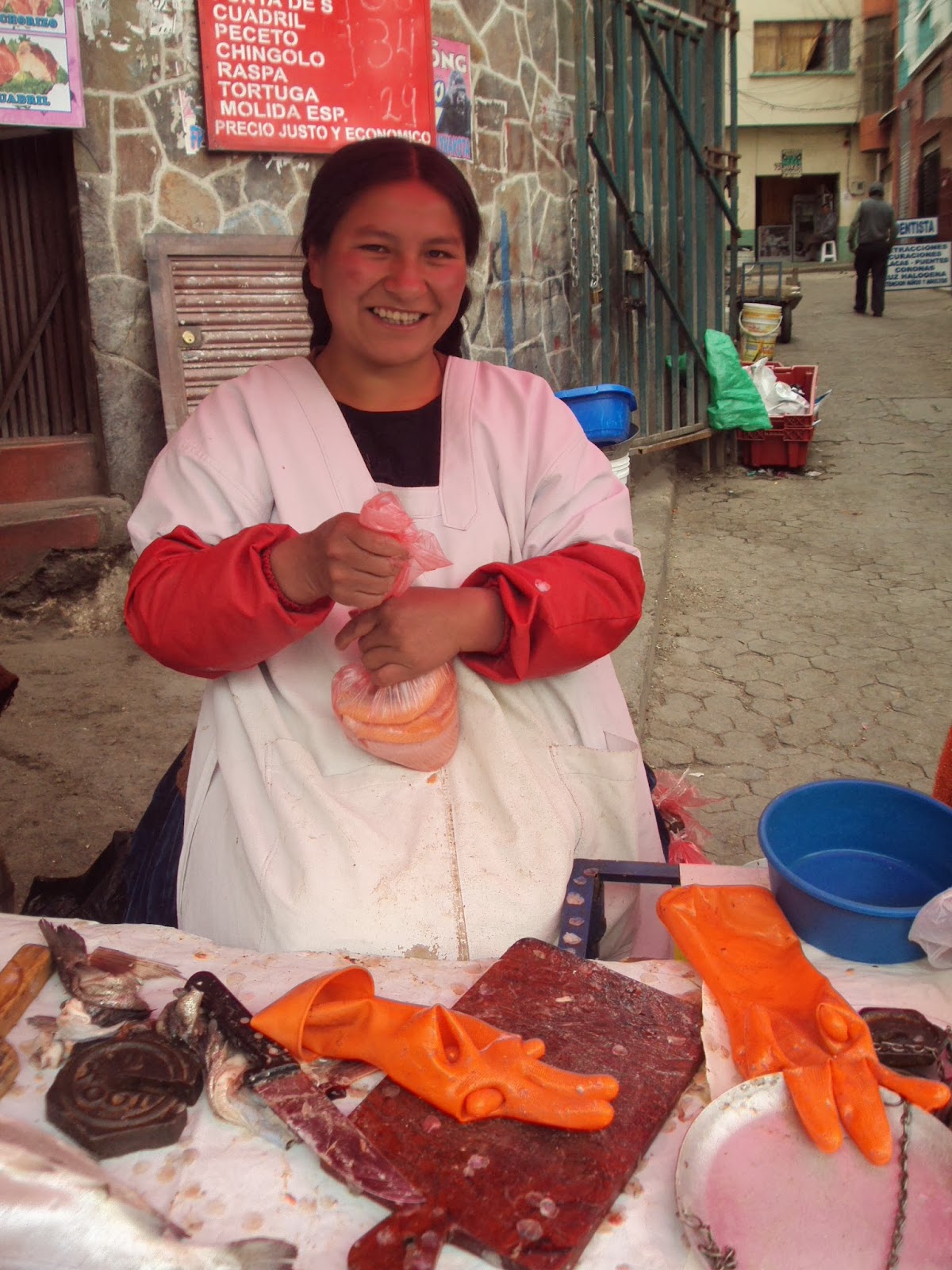
A fishmonger in a landlocked country? Well, take into consideration that nearby Lake Titicaca is the largest freshwater lake in South America and is, also, the world’s highest navigable lake. Situated at 3,810 m above sea level, the lake nutures king-fish, mauri, the boga, suche, ispy and carachi.

Helping me wade through the options, Lidia is my fishmonger in the Rodriguez Farmer´s Market of La Paz, Bolivia. Even though young, she´s been at it years. Taught the business by her mother, the pair continue to work side-by-side selling a full variety of lake fishes al fresco. Most popular are the trout which were introduced in 1939. 

Lidia makes it look easy to skin a trout and her skill amazes me everytime. She advises that without gloves it´s impossible. I prefer to think it´s just impossible and leave it to the professionals... Simply select a fish and in moments it´s boned, skinned and wrapped to go... destined for great things like lemon and cilantro and a glass of white (Cousiño-Macul Sauvignon Gris).
.


Copyright © Mick Huerta 2013. All Rights Reserved. 
 mickhuerta@gmail.com 
 All Accordin' - Travel, Culture, Food, Wine!

Thursday, March 21, 2013

Giving Thanks...


Even big cities rife with daily sounds of car theft alarms and overbearing traffic noise can provide an occasional surprise. Just before first light, early morn, cold fingers of cloud gripped this high altitude Andean city. Not quite yet awake, strains of Pavarotti singing Nessun Dorma (None Shall Sleep) filtered above the rooftops, faint and beguiling it wafted as a godsend. I lifted my head and cocked an ear, then rose from the featherbed to draw the curtains and open windows to better hear. In damp morning haze, a neighbour had bestowed a sonorous gift. I smiled at this Latin city and mouthed the words, "Mil Gracias" (a thousand thanks) to a person I shall never meet. For truly this offering, a musical generosity so freely given has changed my day...

Copyright © Mick Huerta 2013. All Rights Reserved.
mickhuerta@gmail.com
All Accordin' -
Travel, Culture, Food & Wine!


Friday, January 25, 2013

Alasitas: Festival of Abundance - La Paz, Bolivia 2013


Beseeching the Aymara God "Ekeko" to bestow blessings and abundance, Aymara Shamans attend the petitions of participants at the Festival of Alasitas in Plaza San Francisco

January 24th begins the multiple week celebration and first day the city was out in full force to enjoy perfect sunshine amidst the rainy season. One woman commented, "This year, the sun is the first blessing we've received from Ekeko!" All smiles, she and her family felt it was a sign of many good things to come.

Just beyond, a young girl was having stacks of money blessed by a Yatiri (shaman). I snapped a few frames and asked, "Why do you need so much money, chica?" She smiled, "I want to buy gifts for my mother... and for my family!" Her smile grew even larger!

All the personal petitions, wishes and desires of the crowd filled the plaza and overflowed into the surrounding streets. And in the clamor, I thought this ready proof that the Festival of Alasitas is very much alive for it resides in the hearts of the young and the old. Part deep Andean belief, part fiesta and altogether a swirl of color, light and movement; Alasitas is sure to be with us for untold generations as an expression of Andean hope and aspiration.

Copyright © Mick Huerta 2013. All Rights Reserved.
mickhuerta@gmail.com
All Accordin' -
Travel, Culture, Food & Wine!

Tuesday, January 22, 2013

Alasitas 2013 - Jan. 24th

January 24th kicks off the Feria de Alasitas. This is a celebration of abundance that comes at Jallu
Pacha (time of the rains) when the altiplano pops with vibrant green! It's a time of hope and promise when priests, shamans and deeply felt Aymara culture come together to define the wishes/desires of an individual or family. Miniatures are bought of groceries, houses and most anything else and through the incantations of spiritual leaders the Aymara God "Ekeko" is asked to make the objects real. The festival goes on for about a month right in the center of the city of La Paz!

Copyright © Mick Huerta 2013. All Rights Reserved.
mickhuerta@gmail.com
All Accordin' - Travel, Culture, Food & Wines!

Sunday, March 18, 2012

Reading the Sky! - Coroico, Los Yungas, Bolivia

This image was captured in the Yungas Cloud Forest. A young woman caught unawares reading in the sky... if only I knew the title! I'd love to read the book that enthralled her so completely as to mute all else in the world. What supreme serenity yet in the same token, what an other worldly place to read at the bottom of Bolivia's Death Road. - clique once on image to enlarge.

Copyright © Mick Huerta 2012. All Rights Reserved.
mickhuerta@gmail.com
All Accordin' - Travel, Culture, Food & Wine!

Sunday, March 11, 2012

Sancho Panza Succeeds Again! - La Paz, Bolivia

Restaurant Sancho Panza in La Paz continually endeavors to bring the Spanish Table to South America. And in that noble effort, this most recent offering is simply stunning! Huevos Rotos (Broken Eggs)!

This is one of those plates mamas in Madrid make weekly. Fast, easy and sums up being greater than it's parts. Yet any wet blanket could flippantly insist that this is ham & eggs with fried potatoes, a dish common world over. Admittedly yes, more or less.

A chef worth his salt would attest that "it's not what you do but how you do it." And the Madrileños (residents of Madrid) have combined uncomplicated ingredients and made true alchemy. Then Restaurante Sancho Panza gives an inspired twist with a timbal (mold) & applies a free hand with glorious Serrano Ham, a dusting of Smoked Paprika and the result rendered us mum. With our mouths full we contemplated this sublime fusion of ingredients. My companion commented she'd never had anything quite so good and added it was a complete surprise that simplicity could lead to such a pinnacle dining experience. In ensuing conversation, we thought this same recipe would be fabulous with Smoked Salmon, as well. But that would require a departure from tradition and a different wine than the smooth Bolivian Red, Aranjuez Terruño, that we sipped contentedly.

Pablo Zárate Osuna (Madrileño/chef/owner) has the sensibilities to achieve these little triumphs on a plate. Bravo Don Pablo! Restaurante Sancho Panza succeeds once again in the Sopocachi neighborhood of La Paz, Bolivia!

Copyright © Mick Huerta 2012. All Rights Reserved.
mickhuerta@gmail.com
All Accordin' -
Travel, Culture, Food & Wine!

Monday, February 6, 2012

I Believe in Miracles (USD$1.15) - Los Yungas, Bolivia

In the Bolivian tropical zone there are many delights, one of which is the Fried Chicken Dinner available as the sun goes down and the day begins to cool off. In the small pueblo of Coroico, there is a long string of small green kiosks just off the plaza in which women feverishly labor to feed strolling families and ravenous workers recently liberated after a long sultry day of toll. My friend, Marta, is all smiles and cheerfully calls out to neighbours, long time customers and colorful travelers arriving from far flung corners of the world. Oh, does she have the spark! She admits readily she'd like to speak el ingles as even "los chinos" speak English, pues. Conjoling and sweet, she's a natural cook and a bit of a "Master of Ceremonies" all rolled into one.

She explains matter of factly that she uses only corn starch (no salt or pepper) to crisp the chicken which is cut in a way to increase surface area. This results in a quicker cooking time and more crunch in every bite. In addition she's instinctively hit upon a recipe for Pommes Frites (Twice Fried - Belgian Style Fries). She fries peeled, cut & towel dried potatoes 'til barely golden and sets them aside to drain. As the orders come in she drops the cooked potatoes into oil at an even higher temperature to achieve a perfectly crispy chip.

Try this classic Pommes Frites recipe at home; it's dead easy if you attend to detail - Heat a copious amount of oil to 160° C (325° F). Deep fry the potatoes in batches 'til the fries are slightly golden. Drain and allow to cool. For the second round heat oil to 190° C (375° F). Fry the potatoes once again until crispyyyy and golden. Drain, salt and serve immediately. Get ready for the CRUNCH!
Marta!

To the above add Fried Plantain and Llajua (Bolivia's Fiery Sauce). And now you have a Jungle Chicken Dinner which I consider a small miracle for 8 Bolivianos (USD$1.15)!

Copyright © Mick Huerta 2012. All Rights Reserved.
mickhuerta@gmail.com
All Accordin' - Travel, Culture, Food & Wine!

Thursday, October 6, 2011

Coffee, Coca & Thee - Los Yungas, Bolivia


Under a tin-roof in the Yungas cloud forest, I bought a round of cold beer. We sat, just me, a few farmers and their wives sipping & chatting on an afternoon of oppressive heat. Coca leaves were placed on the table for sharing; leaves that had been grown just up the dirt road. The chatter was predictably about banana, citrus and coffee, the principal crops of this subtropical zone. With a roll of the eyes, there was resigned commentary on the international report that coffee prices have hit a 14-year high. Looking around this little village and at the people who work the coffee plants, you might wonder where all the money is. For these small-scale producers, the topic of coffee means lean profit, hard labor and but one harvest a year. On the other end of the spectrum, the coca plant (which is coming into new prominence in this zone) provides three to four harvests in the same period. The price coca brings is higher than that of coffee and it doesn’t need much care. Harvest, dry and sell; that´s it. A simple process that provides more time in a day to work other crops.


The farmers say coffee is problematic. Good coffee requires nurturing ‘til the dry season when the coffee cherries become red ripe and can be harvested. Yet the cherries don’t ripen all at the same time so you must hand pick only the rubies from the branches, place them in baskets and carry them to processing. Then you continually return to the plants and pick only the red cherries until the year’s harvest is complete.

Now the work has only just begun… In the Yungas, they prefer natural drying which is the oldest method of processing coffee. The pulp of the cherry fruit is cleaned away by hand. Then the beans are spread in a thin layer on patios to be dried in the sun. They must be raked and turned and raked and in three to four weeks they will have dried nicely. From there the beans will be milled, hulled, polished, cleaned & sorted. At this point, the beans are bagged and sold to brokers for export. If destined for the Bolivian market they are then roasted, ground and packaged for local sale and consumption.


As we sipped they chewed their coca leaves. In front of each lay a little pile of discarded bits; the farmers were carefully stripping out the stem and the middle rib reserving only the sweet green leaf. With smiles I received assurance that this was the very best; the small tender Yungas leaf grown for chewing not the coarse, large leaf of the Chapare Region (infamously used for cocaine production). The leisurely conversation took a new turn. Roberto Zabala, secretary general of the Afro-Bolivian community, told me frankly the quotas for growing legal coca have increased since Bolivia's first indigenous President EVO Morales took office in 2006. And that they fully understand that EVO will eventually go and quotas will be lowered. And so they're reluctant to dedicate more land to coca plants even though they now earn more. The pendulum will swing the other way and the balance of coffee and coca and fruit will change once again. The on-going challenge for any person living on the land is to survive the intense sun, periods of heavy rain and even the unpredictable politics. Yet for now, they're happy there’s a little more money for buying children's shoes, for repairing houses and investing in equipment that will make future farm work a little easier. One of the wives said you've got to take the good times with the bad. And times are better. Even so, they're also putting something away for whatever is to come. "Things are going to change," another wife said. “They always do.”

All images by Mick Huerta. Taken in the legal Coca fields of Los Yungas, Bolivia.

Copyright © Mick Huerta 2011.
All Rights Reserved.
mickhuerta@gmail.com
All Accordin' -
Travel, Culture, Food & Wine!

Monday, October 3, 2011

Stairway to Heaven or Fast Lane to Prison? Route 36 – The Cocaine Bar of La Paz, Bolivia


Evo Morales took office in 2006 and became Bolivia's first indigenous president. He, himself, is a grower of the Coca leaf and continues as leader of the Coca workers union. The year 2008 saw Morales dismiss the U.S. Drug Enforcement Administration (DEA) and in so doing created a new mood. Though legally speaking, the Bolivian world remains divided into the colors of white and green. It´s a climate of zero tolerance for cocaine (white) and an open heart for the leaf (green). One is gringo and the other native… and between these two extremes there thrives an after-hours disco near the center of the city that unabashedly offers cocaine by the gram. The world’s first openly cocaine bar, Route 36, is much like any disco anywhere on the planet complete with dancing, trippy lights, funky cocktails and big bouncers at the door. But here the rules change just a bit. You need a foreign passport to play; no go if you’re Bolivian. The focus is on international tourists that are passing through while packing ample cash. Route 36 offers a blow-out, a once in a lifetime experience to share back home. Just a little naughty and gone!


And with international currency it really doesn’t cost much to play. When you sit down the waiter takes a drinks order and asks about cocaine for the table. At the equivalent of $22 per gram, a pleased corporate lawyer commented it was 'round the price of two packs of cigarettes home in London. His IT manager wife laughed and ordered yet more Gin Tonics. With cheap cocktails and tall bottles of beer the tables were full of travelers (mostly Euros, Aussies and Kiwis) drawing little white lines. All were generously buying rounds and powder; spirits running high! Evidently, what happens in La Paz stays in La Paz. Not so unusual considering everyone would be moving on in a day or two... no one lingers at 3,650 meters (11,975 ft).

In March 2011, the former head of Bolivia's main anti-narcotics unit was busted for smuggling cocaine along with 15 other police officials being detained for complicity. Shortly thereafter Bolivia withdrew from the UN Convention on Narcotic Drugs. What that means at street level is absolutely nothing. Not to suggest it’s the wild, wild Andes as there’s always caution to exercise. Route 36 sporadically shuts down and reopens in a new location to avoid the heat. You might wonder how to find the latest clandestine location? Ask any radio-taxi driver (formal registered taxis, not hacks)! They keep up on developments and, yes, you’ll pay just a little extra for “on-the-quiet” information but less than $5.00 will easily get you there with companions. Another fiver will return you to your pillow, no matter the hour. And as a tourist in a quiet La Paz hotel room contemplating the light fantastic one may well ask, “Is this a stairway to heaven or the fast lane to prison?” Either, frankly, being a real possibility.

Cameras are prohibited, therefore, these images were taken on the sly.
For Mick Huerta's books - http://www.amazon.com/Mick-Huerta/e/B00MDG6UXK

Copyright © Mick Huerta 2011. All Rights Reserved.
mickhuerta@gmail.com
Travel, Culture, Food & Wine!

Tuesday, August 30, 2011

Slow Travel through the Hinterlands - Bolivia


The journey from the Cochabamba Valley at 2548 m (8360 ft) to La Paz, Bolivia at 4061.5 m (13325 ft) is a trek of a mere 240 Km (149 miles). Doesn´t sound like a great distance but when you consider the less than optimal single lane roads, rest stops and the climb to altitude, the passage requires approximately 8 hours to complete. But fortunately there´s a couple of Bollywood or Jackie Chan films to enjoy on the overheads and my favorite part being the long siesta en route to my destination. Oh, there´s the odd entertainment of babies crawling up the aisle as mothers snooze or the
forever on-going unsolved conundrum of fellow passengers gathering their bundles to make good their escape into the expanse of the Altiplano, no pueblo or gathering of souls to be seen anywhere on the horizon. None, not one, nothing. They get out and move on...

The panoramic vistas are nothing less than stunning all along the way. My trip began with the scruffily overgrown Cochabamba and onto the village of Capinota where two rivers entice amazing amounts of verdant green from the countryside. There the climb begins to wend upward to the Altiplano where scrub vegetation grows sparse and gives way to barren rocks and tufts of scraggy grasses that feed alpacas and llamas. Eventually, you arrive at El Alto, a tenuous huddle of a million people (cum city) sprawling on the edge of La Paz situated in the canyons below. This is one of the few places in the world where the wealthy live at elevations lower than the poor. Why? At these heights the lower the altitude the more oxygen, higher temperatures and the better the gardens grow.

It makes for a long trip but it is more lesson in culture and topography and an opportunity to chat with people I´d never meet otherwise. I don't often travel by bus in Bolivia but when I do I enjoy the experience of slow travel and all it has to offer, including the luxury of not having to drive in an untamed land.

Copyright © Mick Huerta 2011. All Rights Reserved.
mickhuerta@gmail.com
Travel, Culture, Food & Wines